Advise on AI with the law in your hand — not a guess.
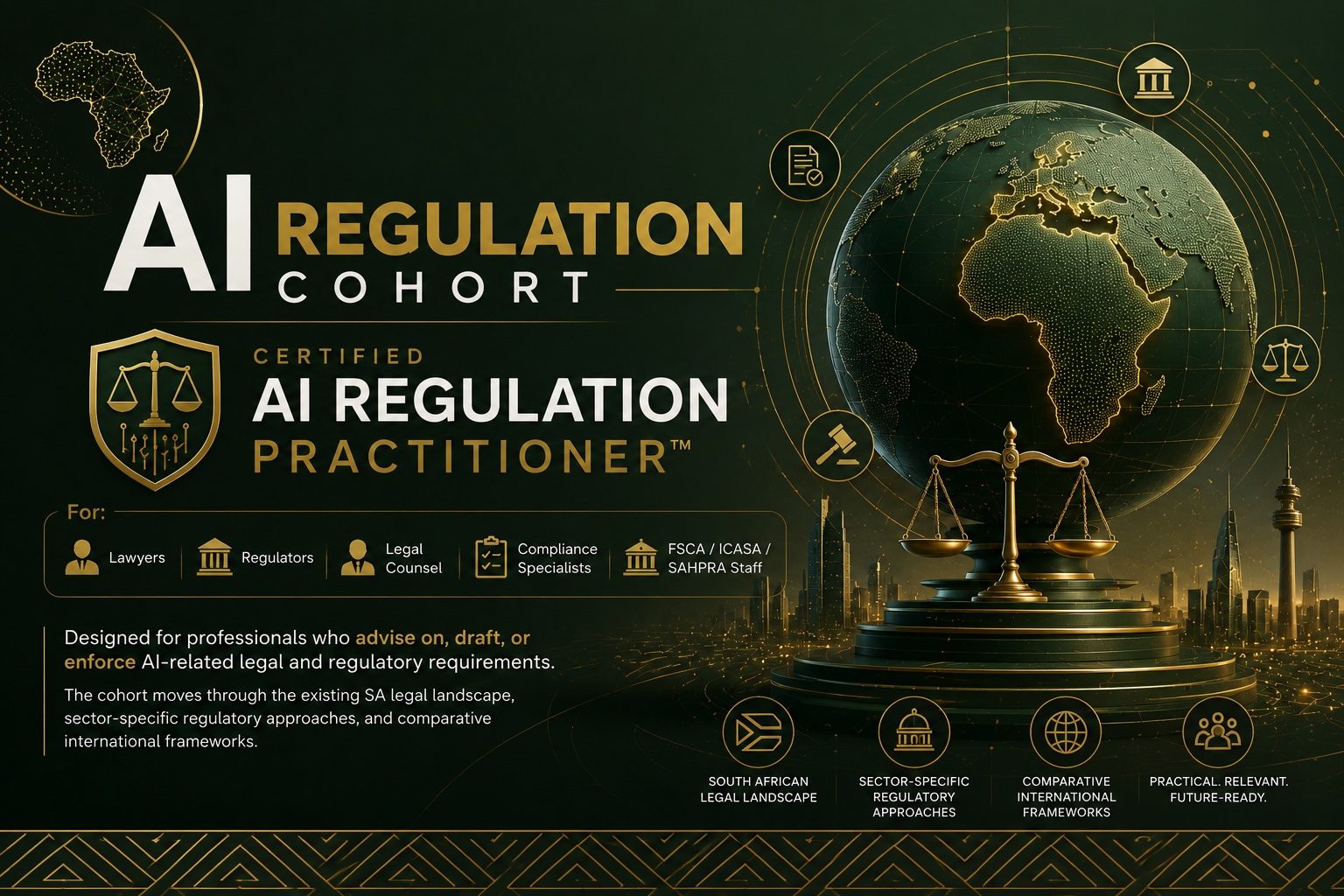
Certified AI Regulation Practitioner™
A guided six-week intensive for the lawyers, regulators and compliance specialists who have to say what the rules are when there is no single "AI Act" to point to. You will leave able to map the existing South African legal landscape onto any AI use case — and with a finished regulatory guidance note you drafted, defended and can stand behind.
The problem we're fixing. There is no single South African "AI Act" — so professionals are told "advise us on the AI rules" and left to stitch together POPIA, the ECT Act, sector regulators and half-understood foreign frameworks under pressure. The result is advice nobody can rely on. This cohort gives you a defensible method for finding the law that already applies, and the skill to write guidance others can act on.
What you'll walk away with
Every week you build one more part of a real regulatory analysis. By the capstone you have a finished, defensible regulatory guidance note for a real SA AI use case — not a pile of statutes.
A finished regulatory guidance note for a real SA AI use case — applicable law, obligations and compliance approach.
A repeatable method for mapping existing SA law onto any new AI deployment.
Command of the SA landscape — POPIA, ECT Act, EEA, NCA and Companies Act director liability applied to AI.
Sector-regulator fluency — how FSCA, ICASA, SAHPRA and HPCSA are reading AI into existing frameworks.
Comparative grounding — EU AI Act, UK and OECD approaches, and what they mean for SA clients.
The Certified AI Regulation Practitioner™ credential — assessed by a domain expert against a published rubric.
Built on the Funda Five™
Sound regulatory advice answers the same five questions our learners ask of every AI decision — translated into legal exposure and obligation.
1 · Task
Characterising the AI use case precisely — because the legal analysis turns on exactly what the system does.
2 · Data
POPIA, lawful processing, automated decision-making rights — the data law that bites first.
3 · Tool
Which sector regulator and framework governs this tool, and how they're interpreting it.
4 · Trust
Evidentiary and product-liability standards — what must be proven and who bears the risk.
5 · Human
Accountability and director liability — "the algorithm decided" is not a defence in SA law.
The six weeks
Each week: a focus, the Funda Five™ lens, a live faculty session, and one concrete thing you build toward your guidance note.
Week 1The South African AI legal landscape
Focus
POPIA enforcement applied to AI systems, ECT Act implications for automated decisions, Employment Equity Act AI exposure, National Credit Act and AI credit scoring, and Companies Act director liability for AI decisions. The law that already governs AI, even without an "AI Act".
Funda Five™
Data & Human — where the existing law bites.
Live session
Faculty walk-through + applying the statutes to a live use case.
You build
Legal Exposure Map for a chosen AI use case.
Week 2Sector regulators & AI
Focus
FSCA guidance on AI in financial services, ICASA and AI in communications, SAHPRA and AI medical devices, and HPCSA clinical AI guidance. How regulators are interpreting and extending existing frameworks for AI contexts.
Funda Five™
Tool — which regulator and framework governs this system.
Live session
Regulator-by-regulator clinic on your sector.
You build
Sector Regulatory Analysis for your use case.
Week 3Comparative international frameworks
Focus
EU AI Act obligations and their SA implications, the UK pro-innovation approach, OECD principles, and how to anticipate South Africa's emerging AI legislation. What foreign law you can borrow from — and what you can't.
Funda Five™
Trust — the standards and obligations worth importing.
Live session
Comparative clinic — mapping EU AI Act tiers onto an SA scenario.
You build
Comparative Obligations Matrix.
Week 4Liability, enforcement & rights
Focus
Product-liability frameworks applied to AI systems, algorithmic accountability, redress mechanisms, human-rights and algorithmic impact, and drafting enforceable obligations rather than aspirational principles.
Funda Five™
Human — who is accountable and how it's enforced.
Live session
Liability & enforcement workshop on your scenario.
You build
Liability & Enforcement Analysis.
Week 5Drafting the regulatory guidance
Focus
The anatomy of a regulatory guidance note: scope, applicable law, key obligations, evidentiary standards, recommended compliance approach and consultation. We draft it together, section by section.
Funda Five™
All five — assembled into defensible guidance.
Live session
Live drafting clinic — leave with a structured draft.
You build
First full draft of your regulatory guidance note.
Week 6 — CapstoneFinalise, review & defend
Focus
Peer review and domain-expert assessment. You revise, then present and defend your reasoning — the test is whether a colleague or a regulator could rely on your guidance.
Assessment
A regulatory guidance note for a specific AI use case in an SA sector (applicable legal framework, key obligations, recommended compliance approach), assessed by a domain expert against a published rubric. One revision opportunity.
You earn
Certified AI Regulation Practitioner™ — demonstrated, not completed.
The toolkit you keep
Legal Exposure Map templateMap any AI use case to the SA law that applies.
Comparative Obligations MatrixSA vs EU/UK/OECD obligations at a glance.
Regulatory Guidance Note templateThe full structure for defensible guidance.
You leave able to give AI legal advice others can rely on — with a finished guidance note to prove it.
No other South African programme trains a lawyer or regulator to assemble the existing legal landscape into defensible AI guidance and then assesses whether they can actually do it. It is the difference between having read the EU AI Act and being able to tell a client what to do on Monday under South African law.
Format, prerequisites & cost
6-week guided intensive · one 90-minute live faculty session each week · weekly build-deliverables · live drafting & comparative clinics · max 20 learners · assessed by a domain-expert (not a facilitator) · capstone in Week 6 with one revision opportunity.
R39,995 / participant
Premium specialist credential · founding-cohort rate. Team and enterprise rates available. SETA/SDL eligibility subject to accreditation.
Prerequisite: Layer 1 Core Certification (AI Judgment Competency Certificate™), or demonstrated equivalent competency assessed on application.
Founding cohort · registering interest now
Advise on AI with confidence.
Register your interest to secure a founding place and be first to know when the next cohort opens. Runs separately from the Core Certification.