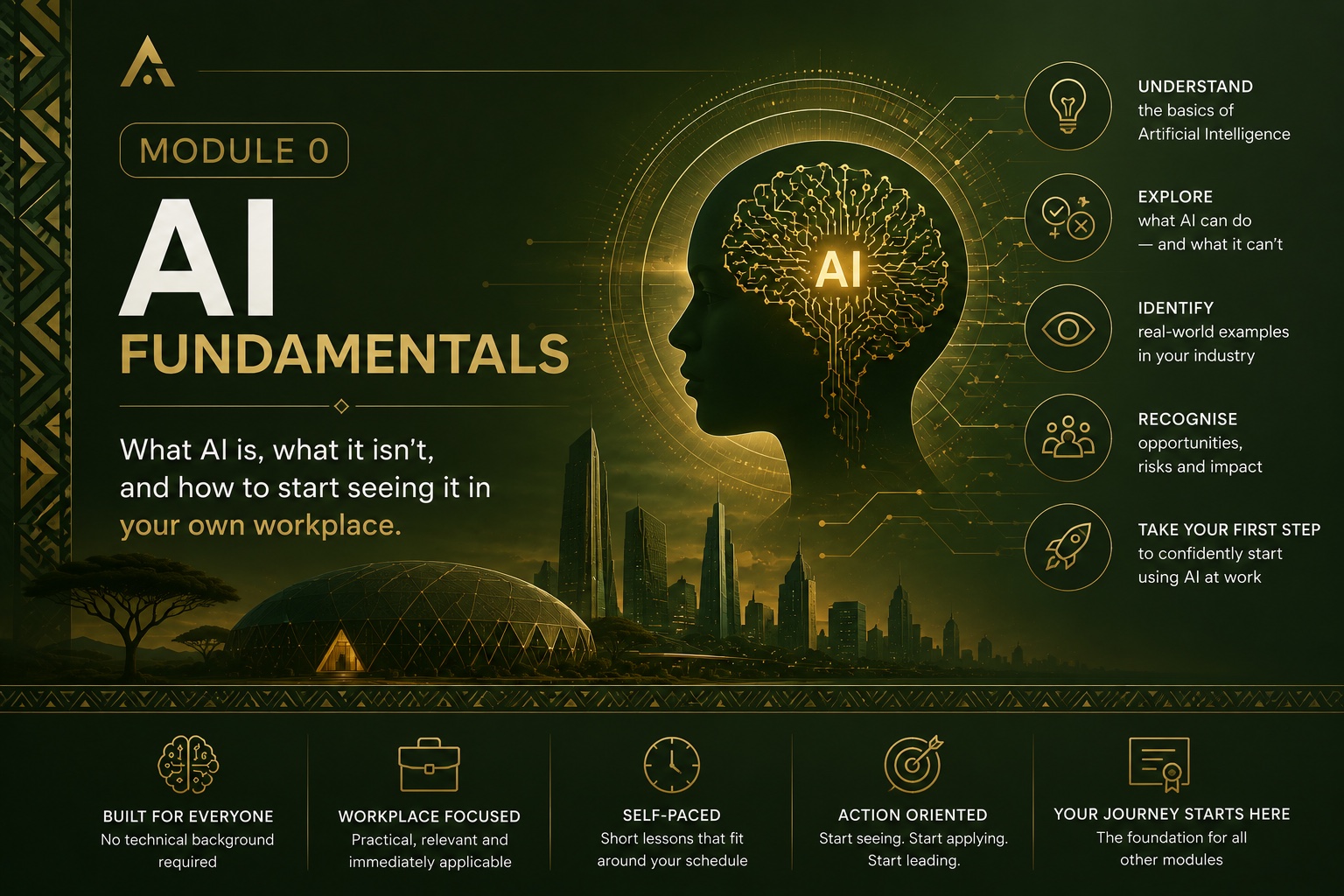
Module 0 — AI Fundamentals: what AI is, what it isn't, and how to start seeing it in your own workplace
Module 0 · Foundation · Free — start here

AI Fundamentals:
What Is It, Really?

Before we get into AI judgment, we need a shared foundation.
No assumptions. No jargon.
This module applies to every learner and every sector — it introduces the concepts you need to recognise AI in your work, understand what it can and cannot do, and spot when confident-sounding outputs may still be wrong. We start with concepts rather than a case study, because AI is new territory for most learners here and the framing helps you recognise what you are about to encounter.

By the end of this module, you will be able to:
  1. Explain the difference between AI and non-AI software using examples from your own work
  2. Name and describe the four types of AI you are most likely to encounter at work in South Africa
  3. Explain why AI outputs can sound authoritative and still be wrong
  4. Identify at least one system or tool you use at work and assess whether it uses AI
55 minutes · 4 phases All sectors · No technical background required Phases 1 & 2 free — register to unlock all phases
1 · Concept
2 · Encounter
3 · Reflect
4 · Apply
1
Concept — What AI actually is
The real explanation, without the hype · ~25 min
Lesson 1 of 7 — The Librarian Analogy

Before we begin

Every generation has had its version of this moment. ATMs were supposed to eliminate bank tellers. Computers were going to make office workers obsolete. In every case, things changed, jobs transformed — and the people who stayed in control were not those who feared the technology or trusted it blindly. They were those who understood it.

The ability to ask "what does this tool actually do, and when should I not rely on it?" made the difference. AI is this generation's version of that moment. This module gives you what you need to understand the tool — so you can shape how it changes your work, rather than having it happen to you.

Lesson 1

The Librarian Analogy

Imagine a librarian who has read every book in the library.

You ask: "How do I start a business?"

The librarian doesn't check whether the answer is true. They recall patterns from all the books — giving you the kind of answer business books tend to suggest.

Key idea

AI can sound like it understands. But it is recognising patterns, not independently verifying whether the answer is true — just like the librarian, at a much larger scale.

Lesson 2

The World's Fastest Guesser

Imagine I show you this sentence:

The sun rises in the _____.

You immediately know the answer. Why? Because you've seen thousands of examples before. Now try this:

Happy birthday to _____.

You can probably guess: you, her, him. Again — you're predicting.

Now imagine you had read an enormous amount of text — books, websites, millions of conversations, billions of examples of how people use language. You would become extraordinarily good at predicting what word is likely to come next.

That is essentially what ChatGPT does

Its core task is prediction — generating the most likely next piece of text from patterns in its training data, not from direct access to truth.

It also doesn't write a whole answer at once. It predicts one small piece of text, then uses what it just wrote to predict the next piece — building the response continuously, word by word.

Try it yourself

Finish these sentences — write the first word that comes to mind:

Lesson 3

Why AI Feels Intelligent

Why can a parrot sound like it understands English?

Because it produces familiar sounds in the right context — without actually comprehending what they mean.

AI feels intelligent for the same reason: it generates responses that fit the pattern of the conversation, learned from enormous amounts of language.

Example

If I ask AI to write a resignation letter — it has seen millions of resignation letters. It predicts what one usually looks like.

But it doesn't know your boss, your feelings, or your company. It may produce a professional-sounding letter while missing the details that actually matter: your notice period, your contractual obligations, or the real reason you are leaving.

It works from patterns, not from personal knowledge of your situation.

Key idea

A response can sound fluent, relevant, and confident without being grounded in the facts that actually matter. Fluency is not the same as accuracy, judgment, or understanding of your specific context.

Pause and think

Think of a message you write regularly at work — an email, a report, a client update. What would AI need to know before its draft could actually be trusted? The relationship with the reader? A policy or legal constraint? The consequence if the message gets something wrong?

Lesson 4

Why AI Makes Stuff Up

Imagine I ask you: "Tell me what happened at my wedding."

You can't know. But some people — trying to be helpful — will guess anyway.

AI does the same thing. When it doesn't know, it predicts. And prediction sometimes creates fiction.

This is called Hallucination

AI is not deliberately lying. It generates plausible-sounding text from patterns — even when it has no verified information to draw on.

Try this yourself

Open ChatGPT, Copilot, or any AI and ask:

What were the three main findings of the 2023 Human Sciences Research Council report on AI use in South African workplaces?

It will likely produce three detailed, specific, confident-sounding findings — complete with percentages and recommendations.

We searched for this report and could not verify it exists. The HSRC does publish material about AI in South Africa — which is exactly why the invented report sounds plausible. AI is completing the pattern of what an institutional report sounds like, not retrieving a real document.

Note: some AI tools can browse the web or retrieve linked documents. But they should show you the source. If no source is cited, treat the output as pattern-generated, not verified.

Verification habit

When AI gives you a specific claim, statistic, study, or citation:

  1. Search the exact title or claim in quotation marks
  2. Check the organisation's official website or publication archive
  3. If you cannot find the original source, do not repeat the claim

Confidence in the answer is not evidence that the answer is correct.

Lesson 5

AI Is Not One Thing

People often picture AI as a robot or a chatbot. But AI also appears in many everyday tools — often quietly, in the background.

🎵
Recommend
Spotify
Suggests music based on your listening patterns
📺
Recommend
Netflix
Suggests shows you're likely to watch
📧
Classify
Gmail
Classifies messages as likely spam or not
📱
Verify
Face ID
Checks whether a face matches an enrolled identity
💳
Estimate risk
Credit Score
Estimates the likelihood of repayment
🤖
Generate
ChatGPT
Predicts the next piece of text

The key insight

AI is not one kind of tool. It can recommend, classify, verify, estimate, or generate. What most AI systems share: they learn patterns from data, then use those patterns to produce a likely output. Not all use the same approach — and not every scoring or filtering system you encounter is necessarily AI-driven.

Lesson 6

Smart at Some Things, Helpless at Others

Being impressive in one area does not mean being reliable in every area.

A dog can recognise faces, learn commands, and solve practical problems — but cannot do mathematics. AI systems are similar: remarkably capable at some tasks, completely unreliable at others.

Where AI is powerful
  • Processing huge amounts of text quickly
  • Finding patterns in data humans would miss
  • Drafting, summarising, translating
  • Identifying patterns in images at scale
Where AI fails
  • Knowing when it's wrong
  • Checking facts or verifying sources
  • Understanding your specific context
  • Taking responsibility for decisions or their consequences
The mistake most people make: "If AI is smart at one thing, it must be smart at everything." That assumption is where most AI mistakes in the workplace happen.

The better question

Not "Is AI smart?" — but: smart at what, trained on which data, in which context, and with what consequences if it is wrong?

Pause and think

Think of one task at your work that AI could do quickly. What would still need a human to check, decide, or take responsibility for?

Lesson 7 — The Most Important Rule

AI is a prediction engine,
not a truth engine.

Once you have this, everything else clicks into place.

Bias?
Prediction from historical patterns that may reflect past discrimination or unequal treatment
Hallucinations?
Plausible-sounding output produced without reliable information to ground it
Recommendations?
Prediction of what you may like, based on patterns in your behaviour and preferences
Credit scoring?
Estimate of repayment risk, based on patterns in past data

If you finish this section understanding only one thing — this is the one. Everything else in this course builds on it.

Now test whether you can spot the difference between a useful prediction and a trustworthy answer.

Demonstration Check 8 questions · you must get all 8 right to continue

1. What best describes how AI works?

2. A generative AI tool gives you a confident, detailed response. What should you do?

3. Spotify, Netflix, Gmail and Face ID all use AI. What do they have in common?

4. Which of these is least likely to be AI?

5. Which question is usually most useful for distinguishing a learning-based AI system from a conventional rules-based program?

6. Why can a generative AI confidently cite a research source that does not exist?

7. Your HR system shortlists CVs before a human sees them. Which type of AI is this most likely to be?

8. A model writes excellent summaries of meeting notes. A manager then asks it to decide whether an employee should be promoted. What is the strongest concern?

2
Encounter — Spot the AI
Now that you know what AI is — spot it in the wild · ~10 min

Below are 10 everyday tools and situations. Pick your gut answer: does this use AI, or not?

Click once to mark AI (green) · click again to mark Not AI (amber) · click a third time to clear.

📧
Gmail spam filter
Automatically puts junk email in your spam folder
AI ?
No human wrote a list of rules for every type of spam. The filter learned patterns from flagged emails and updates when you correct it. That learning from examples is the hallmark of AI. Note: many real filters also combine learned models with some fixed safety rules — a common real-world pattern.
🎵
Spotify Discover Weekly
New music playlist generated for you every Monday
AI ?
A recommendation model analysed your listening history and compared it to millions of users with similar taste to predict what you'd enjoy next. No human curated that playlist. Prediction from patterns across massive data is AI.
📊
Excel =SUM formula
Adds up the numbers in a column
Not AI ?
It executes an exact rule you gave it: add these numbers. It will never get "better" at summing no matter how many times you use it. No learning. No prediction. Software that follows fixed instructions without adapting is automation — not AI.
📱
Face ID / facial recognition
Your phone unlocking when it sees your face
AI ?
It compares a captured facial pattern to your enrolled identity template — a model trained from examples of faces, not hand-written rules about specific features. This card covers device authentication. Broader facial recognition systems that identify people across databases are a different, more contested category covered later in the course.
🔍
Ctrl+F search in a document
Find a specific word in a file
Not AI ?
Scans text character by character for an exact match. No interpretation, no understanding of meaning, no learning. Search "cat" and it won't find "kitten." The same input always gives the same output. Fully deterministic — the opposite of AI.
🛒
"You may also like" product suggestions
Shopping site recommendations based on browsing
AI ?
A recommendation algorithm detected patterns in your browsing, your purchases, and the behaviour of shoppers who bought similar things — then predicted what you'd likely buy next. The output changes as you change. That's AI adapting to you.
📄
A PDF form you fill in manually
Digital form with fixed fields — no automation
Not AI ?
A static digital document. No processing happens until you submit it. The software does nothing with your input on its own — it holds space for your data. Digitising paper is not AI. There is no learning, no prediction, no pattern recognition.
💳
Credit application decision
Your bank loan approved or declined in seconds
AI ?
Some credit decisions use predictive models trained on historical outcomes — income ratios, repayment history, employment type. Others use conventional scorecards or fixed policies. Either way: if historical lending was discriminatory, any model trained on that data learns to repeat those patterns. This is one of the most consequential applications in the course.
📲
Autocorrect on your phone
Your phone predicting your next word while typing
AI ?
Modern autocorrect systems use language patterns to predict what you are likely to type next. Many also learn your personal vocabulary over time. The core mechanism is the same as ChatGPT — just operating at word level rather than paragraph level.
📅
Calendar reminder at 9am daily
A scheduled alarm you set yourself
Not AI ?
You wrote the rule: alert me at 9am. The system executes it exactly, every time, without variation or improvement. This is automation — it follows your instructions. AI, by contrast, figures out its own patterns from data. Knowing this difference is one of the most useful things you'll take from this course.
3
Reflect — What surprised you?
No right answers here — just your honest reaction · ~10 min

Now that you've seen the answers — what caught you off guard?

First — one quick question about your workplace:

Does your organisation use AI directly or in the background of its systems?

Not sure is a valid answer. This course helps you learn what questions to ask before assuming a system is or is not AI.

Use general descriptions only — do not include personal information (names, ID numbers, contact details, salary, medical or disciplinary history).

Now let's go deeper

The one-sentence definition that actually works

What AI is

AI is software that learns patterns from large amounts of data and uses those patterns to make predictions, generate content, or take actions — without being explicitly programmed with rules for every situation.

That's it. No magic. No thinking. No understanding. AI is pattern recognition at massive scale. Let's unpack what that means in practice.

What "learning from data" actually means

Imagine training a new employee. You show them thousands of examples of loan applications that were approved and thousands that were rejected. Over time, they start to notice patterns: applications with certain income-to-debt ratios tend to get approved; applications from certain postal codes tend to get rejected.

AI works similarly — except instead of a person, it's a mathematical model, and instead of thousands of examples, it might be trained on millions. The model doesn't understand credit risk. It doesn't understand people. It has learned to match patterns in new applications to patterns in the training data.

The South African credit context: If historical credit data reflects the effects of apartheid — where Black South Africans were excluded from formal credit markets and forced into lower-income areas — an AI trained on that data will learn those patterns. It may then use postal code as a proxy for creditworthiness without anyone programming it to discriminate. The bias is in the data, not a deliberate choice.

The four types of AI you're most likely to encounter at work

1 Generative AI — makes new content

Examples: ChatGPT, Copilot, Gemini, Claude
What it does: Generates text, images, code, and summaries by predicting what comes next based on patterns in training data
Strength: Drafting, summarising, brainstorming, explaining
Key weakness: Cannot verify facts — it generates plausible-sounding content, not accurate content. It will confidently invent sources, statistics, and names that don't exist.

2 Predictive / Decision AI — makes classifications and scores

Examples: Credit scoring systems, fraud detection, HR shortlisting tools, spam filters
What it does: Takes inputs (a loan application, a CV, an email) and outputs a score, classification, or decision
Strength: Processing many cases at consistent speed — faster than a human reviewer for high-volume decisions
Key weakness: Reflects biases in historical training data. If past decisions were discriminatory, the model learns to repeat them.

3 Computer Vision — makes sense of images and video

Examples: Face ID, medical imaging analysis, security cameras, document scanning
What it does: Identifies objects, faces, text, or anomalies in visual data
Strength: Consistent processing of visual information at scale
Key weakness: Performance drops sharply for faces and scenarios underrepresented in training data — accuracy is often lower for darker skin tones in systems trained primarily on lighter-skinned faces.

4 Agentic AI — takes sequences of actions to achieve goals

Examples: AI assistants that research and draft reports autonomously, book travel, write and run code, send emails, or execute multi-step workflows without a human directing each individual step
What it does: Uses a language model as a “reasoning engine” to plan and carry out sequences of actions — browsing, writing, clicking, submitting — toward a stated goal
Strength: Automating complex, multi-step tasks that would normally require a human to coordinate several tools or systems over time
Key weakness: Each step is a prediction, not a guaranteed correct action — and errors compound across steps. Critically: agentic AI can take real-world actions (sending an email, modifying a file, making a booking) that are difficult or impossible to reverse. Accountability for those actions remains with the person or organisation that deployed it.

Why this matters in your workplace: As AI tools gain the ability to act on your behalf — automatically responding to emails, scheduling meetings, submitting forms — the question of “who approved this?” becomes critical. The Funda Five™’s Human check is even more important when AI can act without a human in the loop.

Five things AI cannot do — regardless of how it sounds

Myth

AI knows facts — it retrieves information like a search engine

Reality

Generative AI generates plausible text based on patterns — it does not retrieve from a verified database. It cannot tell when it is wrong.

Myth

AI is neutral — it makes decisions based on pure data, without bias

Reality

AI reflects the biases in its training data. Data from unequal systems produces AI that perpetuates those inequalities.

Myth

AI understands context — it knows what you mean, not just what you said

Reality

AI processes the text you give it. It has no understanding of your organisation, your situation, or what you're trying to achieve beyond the words in your prompt.

Myth

AI can take responsibility — "the algorithm decided"

Reality

Under South African law and internationally, accountability for AI decisions rests with the people and organisations that deploy them — not the software.

Myth

Confident output = correct output

Reality

AI outputs are expressed with the same tone and style whether they are accurate or completely fabricated. Confidence is not a signal of accuracy.

Demonstration Check 10 questions · you must get all 10 right to continue

This is a demonstration, not a tick-box. You must answer all 10 correctly to move on — each question is marked automatically, anything you miss is explained, and you retake until you've shown true understanding.

1. What best describes how AI works?

2. A bank's AI keeps declining applications from certain postal codes. What's the most likely cause?

3. Which type of AI would most likely be used to automatically shortlist job applications?

4. A generative AI tool gives you a detailed, confident response. What should you do?

5. When an AI system makes a harmful decision, who is legally responsible?

6. Which of these is a clear sign that a tool is AI rather than ordinary software?

7. Which task is a large language model (e.g. ChatGPT) LEAST reliable at?

8. Why does facial recognition often perform worse for darker skin tones?

9. An AI assistant can browse, draft and send emails on your behalf without you approving each step. Which type is this?

10. What does it mean that AI is a "prediction engine, not a truth engine"?

4
Apply — AI in your workplace
Take it back to your own job · ~10 min

You've seen what AI is, what it isn't, and the four types you're most likely to encounter. Now bring it to your world.

Answer these three questions about your own workplace:

Use general descriptions only. Do not include personal information (names, ID numbers, contact details, salary, medical or disciplinary history).

Generative = creates content
Predictive/Decision = scores, ranks, or classifies
Computer Vision = interprets images or video
Agentic = plans and takes multiple steps toward a goal
Not sure = describe what it does