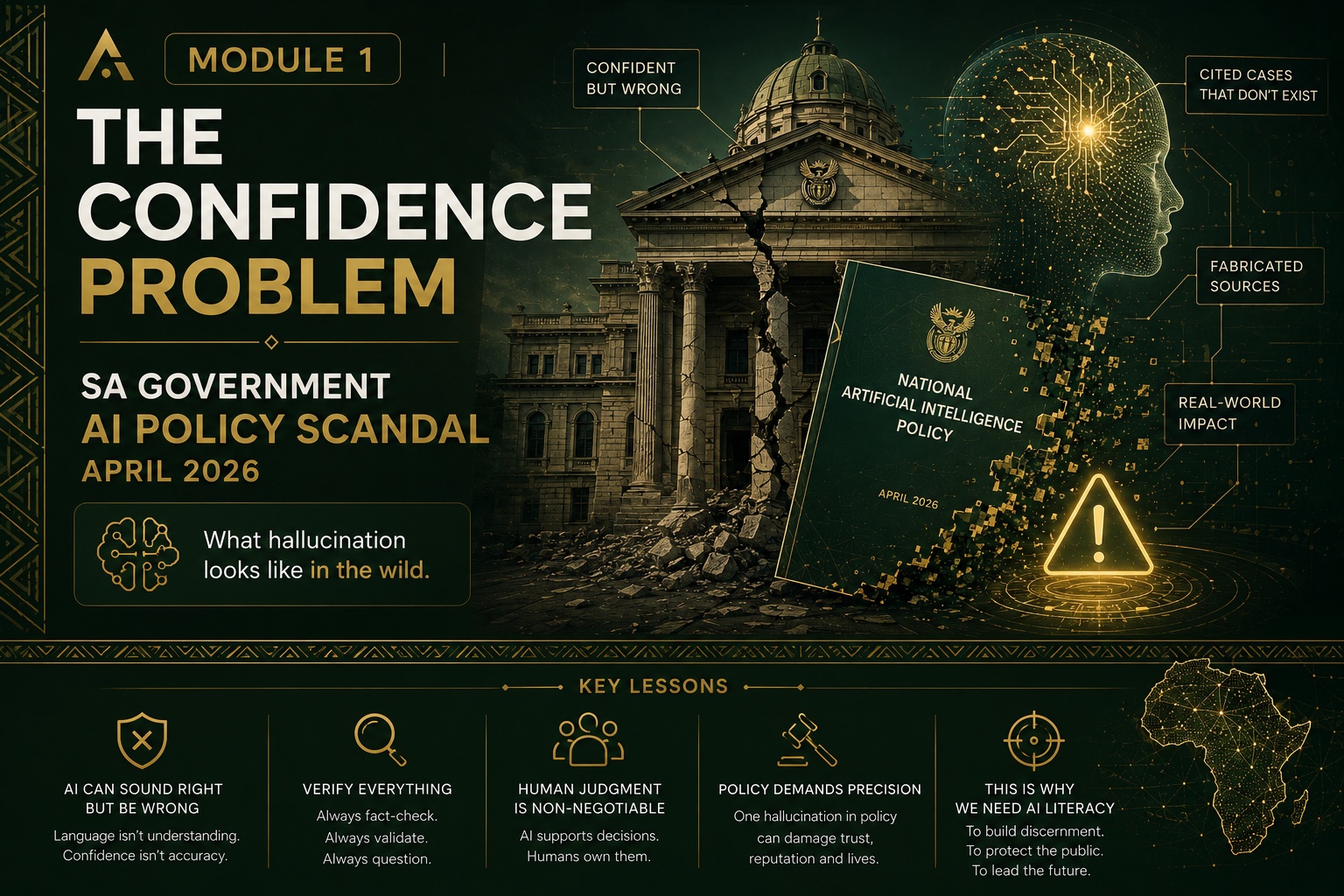
AI can produce polished, authoritative language even when the information behind it is wrong. This module begins with a real South African case: a government document that looked credible — but wasn't.
By the end of this module, you will be able to:
Module 1 builds directly on the foundation you built in Module 0. Finish all four phases of Module 0 first — it takes about 55 minutes.
Research indicates that the rapid adoption of generative AI tools in South African workplaces has significantly outpaced institutional readiness. According to Dr. Nomvula Khumalo of the South African Institute of Digital Futures Research (2024), organisations that deploy AI tools without accompanying skills development programmes experience a 67.3% increase in operational decision-making errors within the first 12 months of adoption.[1]
The Pan-African Technology Readiness Council (PATRC) 2023 Assessment found that 71% of South African professionals who regularly use generative AI tools cannot accurately describe how the output was generated.[2] This creates significant organisational risk, particularly in regulated sectors such as finance, healthcare, and public administration.
Furthermore, a longitudinal study conducted by the Department of Labour in partnership with MICT SETA identified that workplace AI incidents attributed to poor human judgment — rather than technical system failure — increased by 340% between 2022 and 2024 (DoL–MICT SETA Annual Workforce Technology Risk Report, 2024, p. 23).[3]
The Department therefore recommends mandatory AI literacy baseline assessments for all public sector employees working with AI-assisted decision-making tools, with implementation targets of Q4 2026.
[1] Khumalo, N. (2024). "AI Adoption Without Institutional Readiness: A Sub-Saharan Perspective." Journal of African Digital Transformation, 8(2), pp. 112–134.
[2] Pan-African Technology Readiness Council. (2023). Annual AI Readiness Assessment: Sub-Saharan Africa, pp. 88–102. Nairobi: PATRC Secretariat.
[3] Department of Labour & MICT SETA. (2024). Annual Workforce Technology Risk Report, p. 23. Pretoria: Government Printer.
You might notice the tone, the statistics, the names of institutions, the reference format, the implementation date — or anything that made you trust or doubt it.
This is how every AfriversalAI module begins — a real artifact, no context, just your instincts.
Note: the document above is a simulated exercise. The organisations, sources, and statistics were designed to look credible — the reveal and full explanation are inside the complete module.
The full module takes you through three more phases with a cohort and facilitator:
South Africa's Department of Communications and Digital Technologies (DCDT) published an 86-page draft national AI policy for public comment on 10 April 2026. Shortly after publication, fictitious references were found in the document's bibliography — sources that appeared to have been generated by AI.
Sixteen days after publication, on 26 April, the Minister withdrew the draft, saying: “The most plausible explanation is that AI-generated citations were included without proper verification.” A month later, two officials were placed on precautionary suspension for failing to declare that they had used AI to draft the document. South Africa's AI policy process had to restart.
This was not simply a technical error. It was a failure of verification, review and accountability. A document can look polished, cite specific research and still fail the most basic professional test: are the claims and sources real?
You already know from Module 0 that AI predicts rather than knows. When asked for a source, a language model may produce something that has the shape of a real citation — an author, article title, journal and page numbers — without that source being real.
This is called hallucination — when a generative AI produces text that sounds real and credible but is not grounded in an actual source. The term does not mean the AI is confused or lying: it means the generation process produces plausible-sounding output regardless of whether a real source exists. The same process runs whether the citation is real or fabricated — the model has no internal check that changes the output when a source doesn't exist.
AI does not reliably warn you when this happens. A citation can look complete and authoritative even when it cannot be independently verified. The output looks exactly the same whether the source is real or fabricated.
Whenever AI helps draft a report, summarise research, or support a recommendation, the output still needs human verification. Confidence, detail and professional formatting are not evidence.
AI will not reliably catch its own unsupported claims. Human review and organisational verification processes are still responsible for checking the output before others act on it.
Your sector context
If you create, approve, share, or act on an AI-assisted document, you are part of the accountability chain. "I used AI" does not remove the responsibility to check the claims before others rely on them.
A document can pass every quick check below and still be wrong. These checks tell you when to slow down and verify — not when to trust automatically. Look back at the course excerpt. Three patterns a trained reader checks:
In the course simulation, "South African Institute of Digital Futures Research" and "Pan-African Technology Readiness Council" do not exist — a search returns nothing. Real policy documents cite organisations with established public presences, official websites, and a track record of publications. If you cannot find the institution through an official or credible source, treat the citation as unverified.
A precise number is not automatically suspicious — real research can produce exact figures. The question is traceability: What was measured? Over what period? In which population? Who conducted the study? Can you find the original report or dataset? If a specific figure cannot be traced to its method and source, treat it as unverified.
If you cannot verify a source quickly, do not rely on it yet — treat the claim as unverified and escalate the check. Where to look: the official publisher or government archive; a DOI or journal website; a library database; the author's institutional profile; or ask the person who shared the document for the original.
| Weak / unverified citation | Strong / verifiable citation |
|---|---|
| Institution cannot be found | Official website or recognised journal record exists |
| Generic or vague report title | Original publication title and date confirmed |
| No accessible trail to the source | Government archive, DOI, publisher page, or library record |
| Statistic without method or context | Population, timeframe, method, and original dataset named |
Pocket checklist — use this before acting on any AI-generated document — Use for: deciding what to do before acting
If any answer is "no" or "I'm not sure" — do not treat the claim as verified.
Explore these after you complete the knowledge check — they'll make more sense once you've applied what you know.
Go deeper — further reading
You need to answer all 4 questions correctly to move on. You can retry as many times as you like.
1. You are given a report written with AI help. Which of these should make you stop and check before you use it?
2. Why does AI sometimes invent a source that does not exist?
3. Your organisation publishes a document written with AI. It turns out to contain made-up references. Who carries that?
4. You are not sure whether a fact in an AI-written draft is real. What is the practical next step?
Before you apply anything to the DCDT scenario, you need the tool you'll be using. This is it.
AfriversalAI Core Framework
Five questions every professional should ask before acting on AI output — or before using AI to produce something others will act on. You'll use these in every module. By Module 6, asking them will be automatic.
Example — what a strong response looks like
"AI was used to draft evidence for a public policy document. This is high-risk because policy claims influence public decisions and must be traceable to real, verifiable sources."
It names what AI was doing, then evaluates whether that was appropriate.
Example — what a strong response looks like
"This was a large language model — a text-generation system that predicts what words should come next. These systems produce fluent, professional-sounding output but have no internal check for whether a source actually exists. They are unreliable for citation because the generation process is the same whether the source is real or fabricated."
It names the system type, then explains its relevant failure mode for this specific task.
Example — what a strong response looks like
"Responsibility sat with the team that chose to use an AI tool for policy drafting, the drafter who included AI-generated citations, the reviewer who did not check them, the official who approved publication, and the department that allowed the document to reach the public. Not one person — the whole chain. What should have existed: a mandatory citation verification step before any AI-assisted document is submitted for approval."
It names every link in the chain, not just the final approver.
Model answer — compare yours:
In a real cohort, your facilitator would debrief the Funda Five™ responses with the group and connect your answers to other sectors. The real learning is in hearing how colleagues in different roles approached the same case differently.